hipthrusts
HipThrusTS, visually
Seven views that explain how HipThrusTS works and why it exists:
- The lifecycle — the eight stages and how flow control moves through them
- Failure routing — how each stage’s failures map to client-safe responses
- From raw request to initial context — the trusted and untrusted halves of a request, and why unsanitized slices can’t survive
- The context only grows — how every stage layers its contribution onto what came before
- Composition with
HTPipe— one request sweeping the whole pipe stage by stage, with each merged stage’s typed output exposed for further composition - Stage dependencies are type-checked — a stage whose input can’t be satisfied upstream is a compile error
- Adapters — thin edges around a framework-free middle
Simple flows are Mermaid (GitHub renders it natively, and it’s reviewed in
the same diff as the code it describes). The spatial ones — the growing
context stack, the pipe sweep, the adapter surface — are hand-drawn SVGs
in img/, also plain text in the diff, drawn with theme-neutral
colors so they read correctly in both GitHub light and dark mode.
1. The lifecycle
Every handler is the same eight stages (five required, three optional),
run in a fixed order by executeHipthrustable.
Authorization stages return true to pass, false to deny, or an
object to pass and contribute that object’s keys to the context.
flowchart TD
    RAW(["Raw request<br/>(framework-specific)"])

    EA["<b>extractAmbient</b> · optional, sync<br/>lift trusted ambient: auth principal, request ID"]
    EI["<b>extractInputs</b> · optional, sync<br/>adapter-specific input shaping"]
    SI["<b>sanitizeInputs</b> · required, sync<br/>untrusted in → validated, typed out"]
    PA{"<b>preAuthorize</b> · required, sync<br/>cheap check before touching the DB"}
    LR["<b>loadResources</b> · optional, async<br/>fetch the resource the request is about"]
    FA{"<b>finalAuthorize</b> · required, async<br/>ownership check with the resource in hand"}
    EX["<b>execute</b> · required, async<br/>the actual work"]
    RR["<b>redactResponse</b> · required, sync<br/>strip fields the caller may not see"]

    RESP(["Safe response"])
    DENY(["HipForbidden → 403"])

    RAW --> EA
    EA -->|"ctx.ambient = { user, … }"| EI
    EI -->|"unsafe inputs"| SI
    SI -->|"ctx.inputs = validated shape"| PA
    PA -->|"true / object → spread into ctx"| LR
    PA -->|"false"| DENY
    LR -->|"ctx.thing = loaded doc"| FA
    FA -->|"true / object → spread into ctx<br/>e.g. { isOwner: true }"| EX
    FA -->|"false"| DENY
    EX -->|"unsafe response"| RR
    RR --> RESP
The five required stages are mandatory by construction: an adapter won’t accept a config that’s missing one — it’s a compile error, not a code-review catch.
2. Failure routing
Flow control on the unhappy path is just as fixed as the happy path.
Throw a HipError from any stage and the adapter translates it to the
right transport response (HTTP status, or TRPCError code). Anything
unexpected thrown from a stage is routed by which stage it escaped
from — so a dropped DB connection can never masquerade as “not found,”
and no stack trace ever leaks to the caller.
flowchart LR
    subgraph STAGES["Stage that threw"]
        direction TB
        S1["extractAmbient / extractInputs / sanitizeInputs"]
        S2["preAuthorize / finalAuthorize<br/>returned false"]
        S3["any stage:<br/>threw a HipError deliberately"]
        S4["preAuthorize / loadResources /<br/>finalAuthorize / execute / redactResponse:<br/>unknown throw (bug, outage)"]
    end

    subgraph OUT["What the client sees"]
        direction TB
        E422["HipBadInputs → 422<br/>(these stages exist to reject bad input;<br/>original error chained as cause)"]
        E403["HipForbidden → 403"]
        EMAP["That error's own status:<br/>HipNotFound → 404, HipConflict → 409,<br/>HipUnauthorized → 401, …"]
        E500["HipInternal → 500<br/>one scrubbed message,<br/>cause chained for logging"]
    end

    S1 --> E422
    S2 --> E403
    S3 --> EMAP
    S4 --> E500
3. From raw request to initial context
A request object carries two very different kinds of data, and the first
two lifecycle stages exist to keep them apart. Things the caller
controls (params, body, query, headers) are untrusted and must pass
through sanitizeInputs. Things your own middleware produced before
the handler ran (req.user from your auth layer, a request ID, a locale)
are trusted, and extractAmbient lifts them directly.
flowchart TD
    REQ["request object"]

    subgraph UT["untrusted — the caller controls this"]
        P["params"]
        B["body"]
        Q["query · headers · …"]
    end
    MW["trusted — produced by your own<br/>prior middleware: req.user, request ID"]

    SI["<b>sanitizeInputs</b><br/>validate every slice you want to keep"]
    EA["<b>extractAmbient</b><br/>lift what you already trust"]

    DROP(["slices you didn't sanitize are deleted<br/>at the stage boundary — consuming one<br/>downstream is a compile error"])
    CTX["<b>initial context</b><br/>ctx.ambient — trusted<br/>ctx.inputs — validated"]

    REQ --> UT
    REQ --> MW
    P -->|"validated"| SI
    B -->|"validated"| SI
    Q -.->|"not sanitized"| DROP
    MW --> EA
    SI -->|"ctx.inputs"| CTX
    EA -->|"ctx.ambient"| CTX
That drop is the strictness guarantee: slice sanitizers pass the raw
remainder to each other on a hidden UNSAFE_SLICES channel, and core
deletes that channel the moment the stage completes — at runtime and in
the types. Want a raw slice through anyway? Say so explicitly
({ query: (q) => q }) — a visible, greppable decision instead of a
silent default.
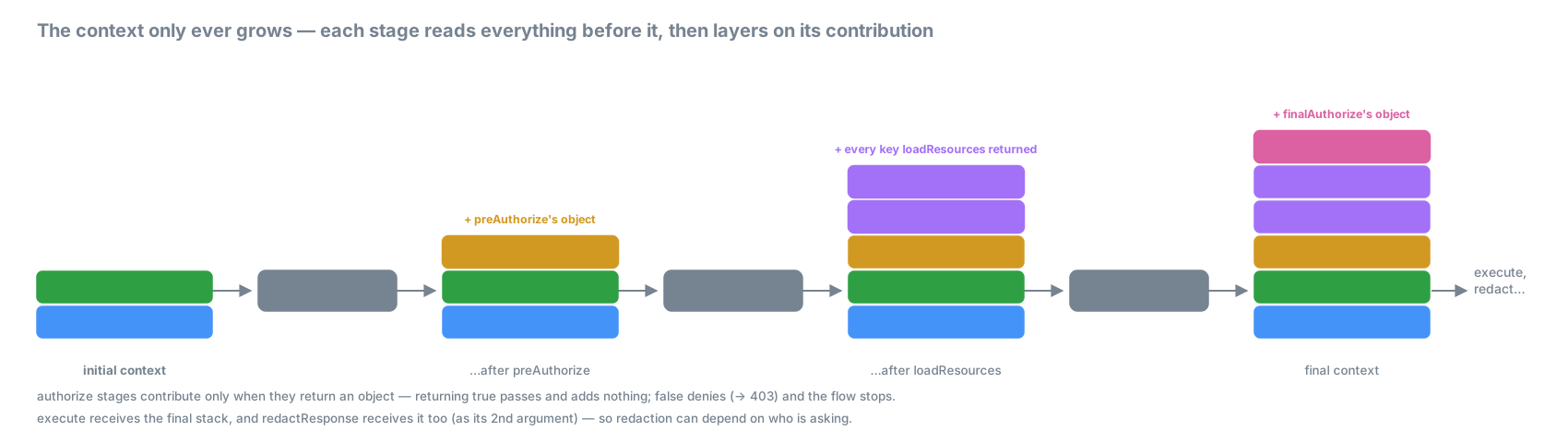
4. The context only grows
From the initial context onward, every stage receives everything earlier
stages produced and layers on its own contribution. execute written at
the end of a long chain can reach ctx.ambient.user,
ctx.inputs.params.id, ctx.thing, and ctx.isOwner — with full type
inference.
5. Composition with HTPipe
HTPipe(...) merges reusable fragments — “lift the user,” “sanitize
these slices,” “load the Thing and require ownership” — into one complete
handler. The merge is stage by stage, not end to end: at runtime, each
lifecycle stage sweeps left-to-right across every input that declares it,
threading the accumulating context through; only then does the request
wrap back to the start of the pipe for the next stage.
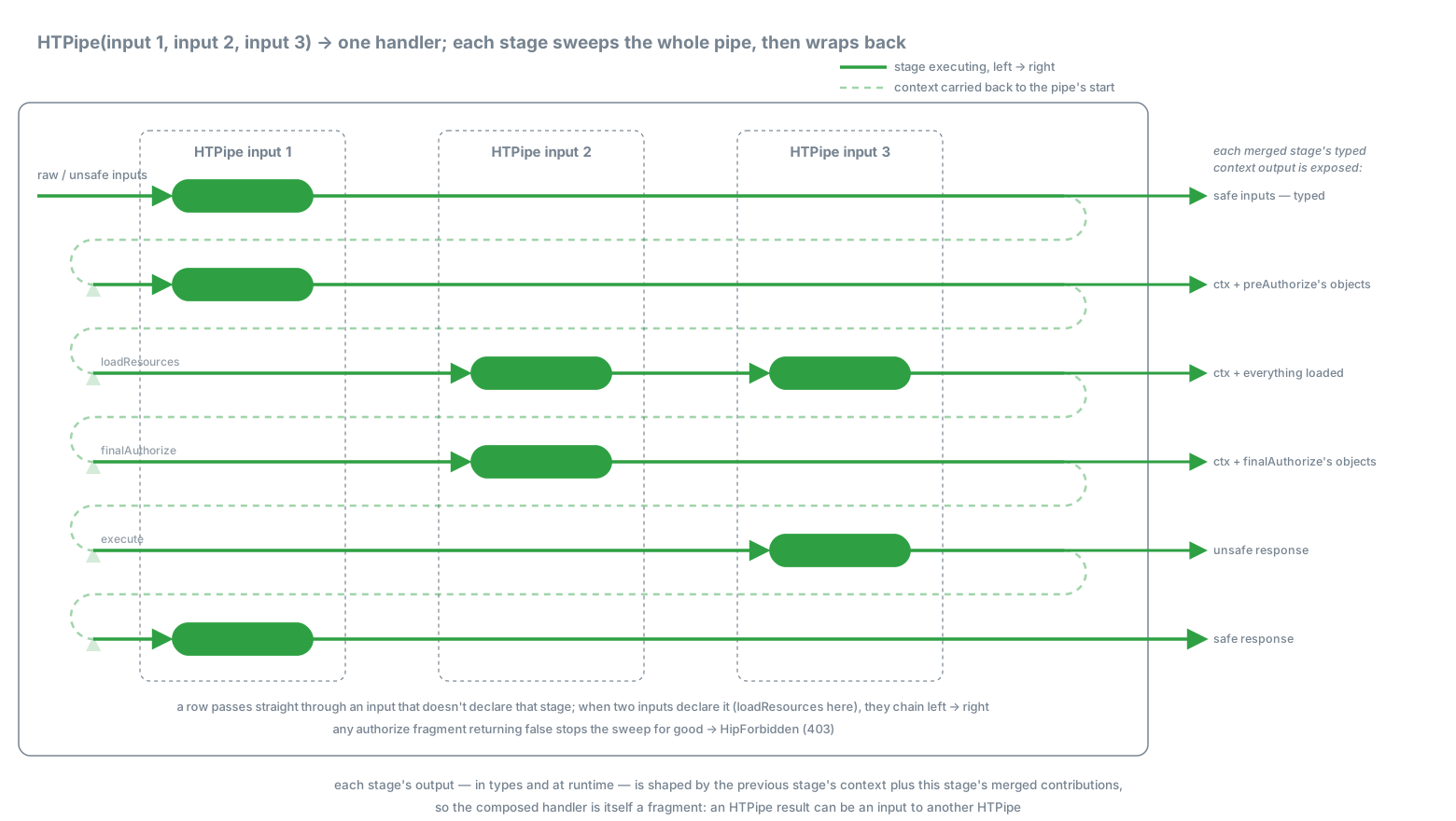
Note the arrows coming out on the right: the merge produces a real
stage per row, whose output — in types and at runtime — is the previous
stage’s context plus this stage’s combined contributions. That makes the
composed handler a fragment like any other: an HTPipe result can be an
input to another HTPipe.
Per-stage chaining rules, for the curious: sanitizeInputs and
redactResponse chain output→input (so redactors stack); loaders and
authorizers merge their object contributions (right wins on a key clash);
execute runs both and keeps the right result. And
finishPipe(pipe, handler) finishes the dominant authoring shape — one
shared pipe plus one endpoint-specific trailing handler — with the
trailing handler’s context types inferred from the pipe, so its callbacks
need zero annotations.
6. Stage dependencies are type-checked
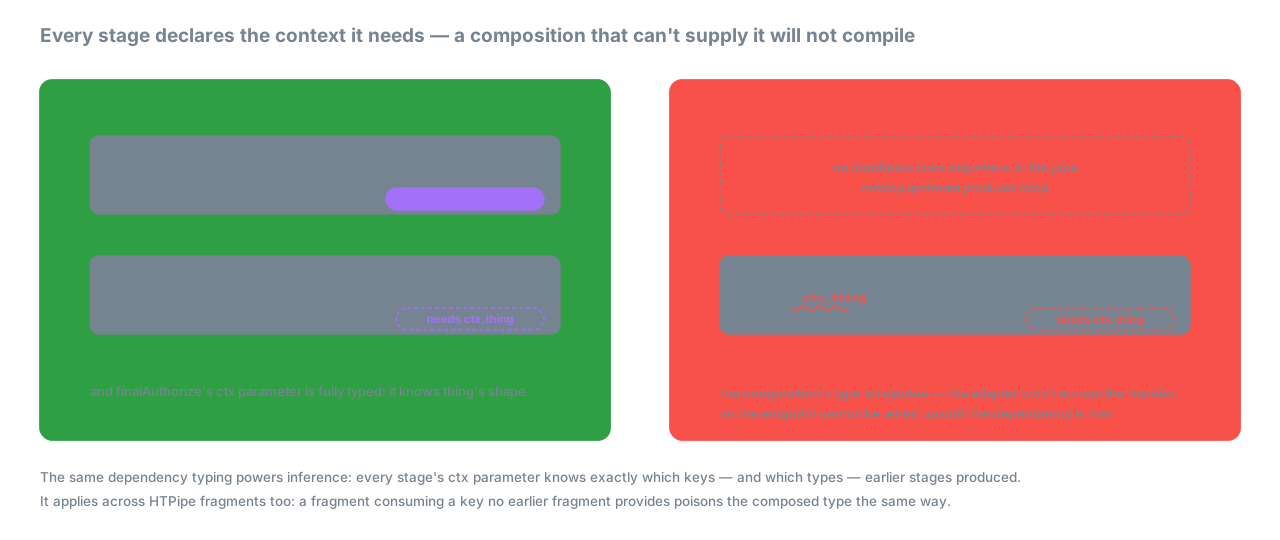
The accumulation and composition above aren’t just runtime behavior —
they’re carried in the types. Every stage’s context parameter declares
what it needs, and a handler (or pipe) whose upstream stages can’t supply
a declared key is rejected at compile time with a named
HipDepNotMet<'stage', 'key'> marker, so the endpoint can’t be wired up
at all.
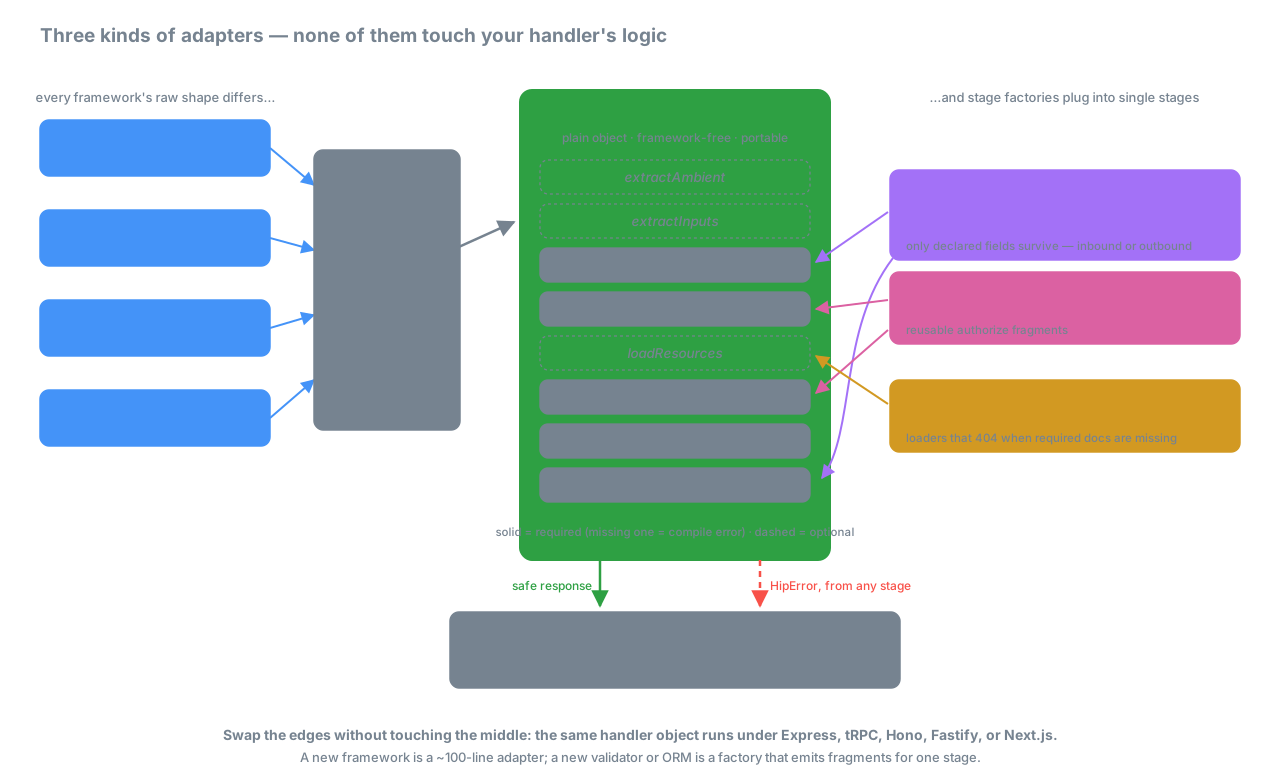
7. Adapters
The middle is framework-free; only the edges know what framework you’re on. Endpoint adapters (~100 lines each) canonicalize the raw request on the way in and translate the outcome on the way out. Stage factories — Zod for validating inputs and redacting responses against schemas, Mongoose for loading, role/assignee helpers for authorization — emit fragments for one specific stage. The same handler object runs unchanged under any of them.