hipthrusts - v1.2.0
HipThrusTS


Secure-by-default request handlers for Node.js APIs.
Every secure endpoint does the same things: validate inputs, authorize, load resources, do the work, redact the response. Most frameworks make all of them optional — the handler that forgets one still compiles, still ships, and shows up six months later as a privilege-escalation report. HipThrusTS makes the stages the unit of work, and makes the required ones impossible to skip:
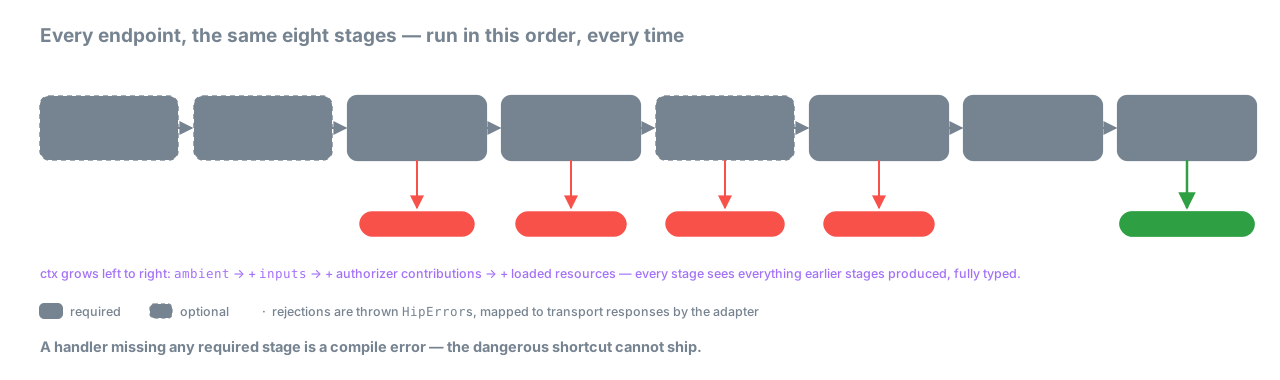
It sits on top of the framework you already use — Express, tRPC, Hono, Fastify, or Next.js (App Router). It doesn't replace your router, your ORM, or your auth layer — it gives the per-request handler a backbone.
import { toExpressHandler } from 'hipthrusts/express';
app.get('/things/:id', toExpressHandler({
extractAmbient: (raw) => ({ user: raw.req.user }),
sanitizeInputs: (inputs) => ({ id: String(inputs.params.id) }),
preAuthorize: (ctx) => ctx.ambient.user?.role === 'reader',
loadResources: async (ctx) => ({
thing: await ThingModel.findById(ctx.inputs.id).exec(),
}),
finalAuthorize: (ctx) =>
!!ctx.thing && ctx.thing.ownerId === ctx.ambient.user.id,
execute: (ctx) => ctx.thing,
redactResponse: (thing) => ({ id: thing.id, name: thing.name }),
}));
Delete any of the five required stages and TypeScript fails the build.
Throw a HipError (HipNotFound, HipForbidden, …) from any stage and
the adapter translates it to the right HTTP response — without leaking
error details to the caller.
You'll like HipThrusTS if you're building a Node.js API with a data model, untrusted clients, and at least one of these concerns:
- resource-level access control (owner-only, role-based, assignee-based)
- field-level permissions (some fields are read-only for some callers)
- response redaction (passwords, tokens, internal flags must never leak)
- making security review of every endpoint mechanical, not human
The context only grows
Each stage receives everything earlier stages produced and layers on its
own contribution — ctx.ambient from extraction, ctx.inputs from
sanitization, loaded resources and authorizer outputs at the top level.
An execute at the end of a long chain reaches all of it, fully typed:
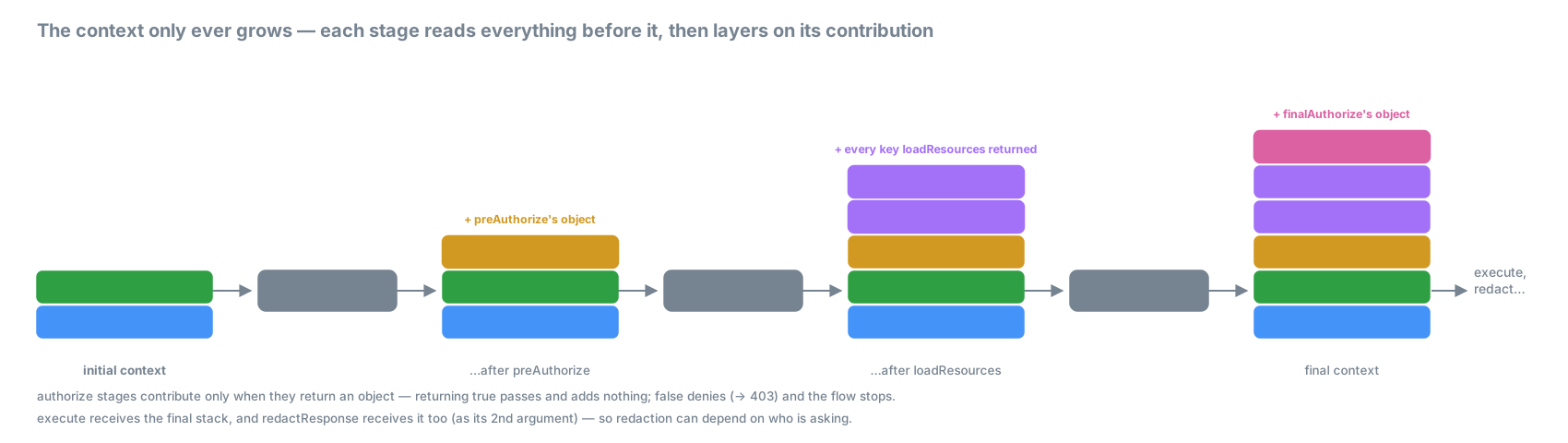
An authorizer can even do its check and contribute at the same time —
return { isOwner: true } instead of true, and downstream stages see
ctx.isOwner.
Compose, don't repeat yourself
The real payoff shows up the second time you need "load a Thing by ID,
require the caller to own it." Write it once as a fragment, then HTPipe
it into every endpoint that needs it:
import { HTPipe, LoadResources, FinalAuthorize } from 'hipthrusts';
export const RequireThingOwner = HTPipe(
LoadResources(async (ctx: { inputs: { params: { id: string } } }) => ({
thing: await ThingModel.findById(ctx.inputs.params.id).exec(),
})),
FinalAuthorize((ctx: { thing: any; ambient: { user: { id: string } } }) =>
ctx.thing && ctx.thing.ownerId === ctx.ambient.user.id
? { isOwner: true as const }
: false,
),
);
// every owner-gated endpoint is now a few lines
// (WithUserFromReq / SanitizeThingParams: shared fragments, see the docs):
app.put('/things/:id', toExpressHandler(HTPipe(
WithUserFromReq, SanitizeThingParams, RequireThingOwner,
{
preAuthorize: (ctx) => ctx.ambient.user?.role === 'editor',
execute: async (ctx) => { ctx.thing.name = ctx.inputs.body.name; return ctx.thing.save(); },
redactResponse: (t) => ({ id: t.id, name: t.name }),
},
)));
The merge is stage by stage — each lifecycle stage sweeps across every fragment that declares it, and the composed result is itself a fragment:
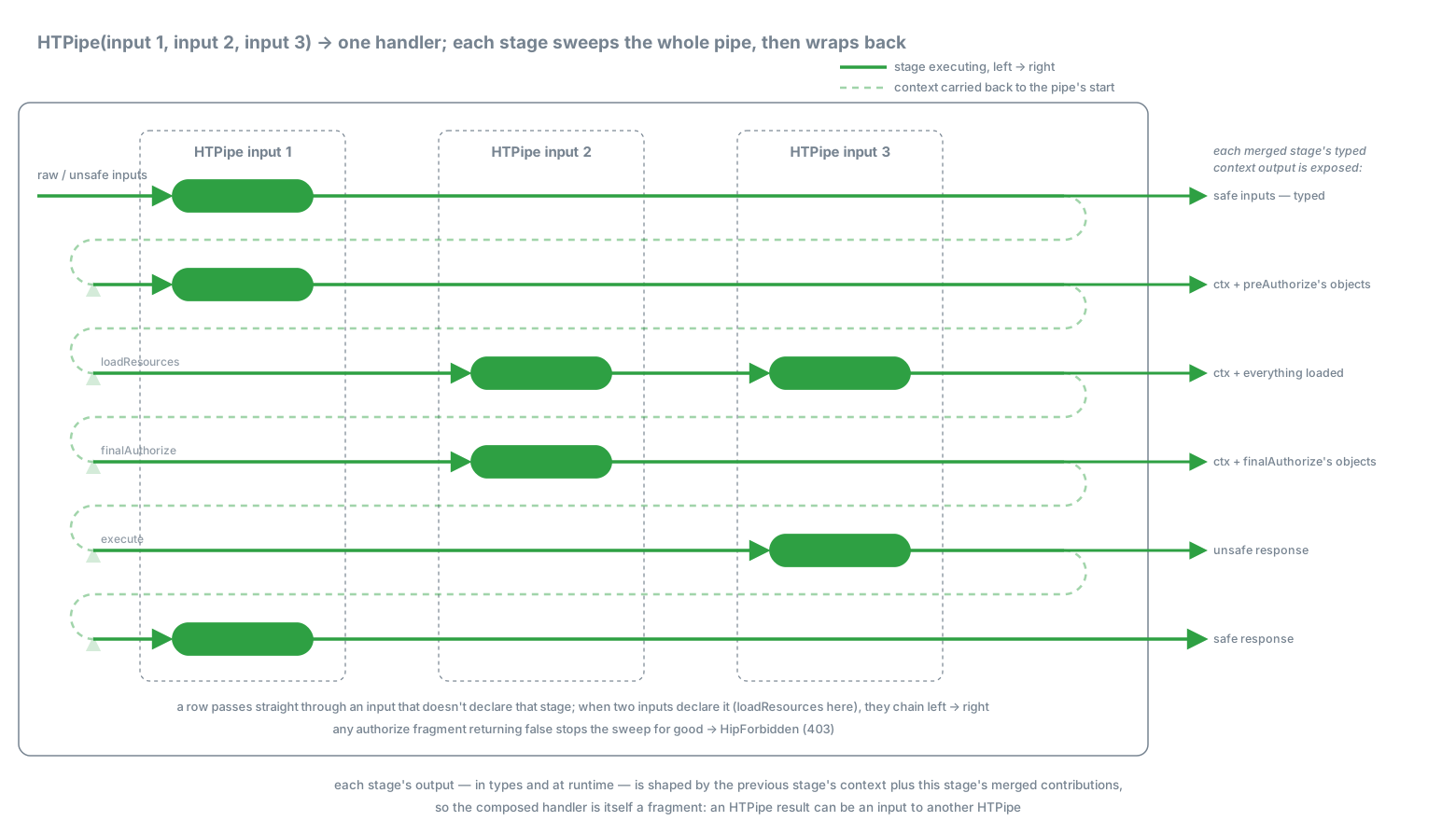
A stage that consumes a context key nothing upstream provides is a
compile error (a named HipDepNotMet<'stage', 'key'> marker), so a
pipe can't silently lose its auth or its data. Full details, including
shared partial pipelines and the zero-annotation finishPipe helper:
docs/composition.md.
Install
pnpm add hipthrusts
# peer-installs depending on what you'll use:
pnpm add express # Express adapter
pnpm add hono # Hono adapter
pnpm add fastify # Fastify adapter
pnpm add next # Next.js (App Router) adapter
pnpm add zod # Zod-based validation helpers
pnpm add mongoose json-mask # Mongoose helpers
Ships ESM + CommonJS, root and every subpath (hipthrusts/express,
hipthrusts/zod, …). Node.js >= 20. Subpath types resolve through the
package exports map, so use "moduleResolution": "node16",
"nodenext", or "bundler" in your tsconfig.json — the legacy
"node" (node10) resolution cannot see the subpath type declarations.
Documentation
| Guide | What's in it |
|---|---|
| The lifecycle, in detail | All eight stages, the context each receives, input slices & the strictness guarantee |
| Composition | HTPipe, shared fragments, partial pipelines, finishPipe, type troubleshooting |
| Errors & failure routing | The HipError vocabulary, error bodies, unexpected-error routing, the auth-before-validation gate |
| Adapters | Express, tRPC, Hono, Fastify, Next.js; responseMeta, onError / afterResponse options |
| Zod validation helpers | Schema-backed sanitization & redaction, codec-style wire schemas, switches |
| Mongoose helpers & data loading | Everyday loaders, ctxRef, tenant scoping for list endpoints |
Plus the generated API reference (every export, from source) and runnable examples — a hello-world per adapter:
pnpm exec tsx examples/express-hello.ts
No magic
The helpers (HTPipe, LoadResources, the htZodFactory family) all
just produce or compose plain objects — a handler is data; the adapter
executes it. Here's the opening example written longhand, with nothing
but built-in TypeScript:
import { HipBadInputs, HipForbidden, HipNotFound } from 'hipthrusts';
import { toExpressHandler } from 'hipthrusts/express';
app.get('/things/:id', toExpressHandler({
extractAmbient: (raw) => ({ user: raw.req.user }),
sanitizeInputs: (inputs) => {
if (typeof inputs.params?.id !== 'string') {
throw new HipBadInputs('id must be a string');
}
return { id: inputs.params.id };
},
preAuthorize: (ctx) => ctx.ambient.user?.role === 'reader',
loadResources: async (ctx) => {
const thing = await ThingModel.findById(ctx.inputs.id).exec();
if (!thing) throw new HipNotFound('Thing not found');
return { thing };
},
finalAuthorize: (ctx) => {
if (ctx.thing.ownerId !== ctx.ambient.user.id) {
throw new HipForbidden();
}
return true;
},
execute: (ctx) => ctx.thing,
redactResponse: (thing) => ({ id: thing.id, name: thing.name }),
}));
Philosophy
- Secure by default, not by convention. The compiler enforces the required stages; reviewers don't have to.
- Reusable, not opaque. Common patterns (ownership, role checks, populate-this-resource) become named fragments you compose. No magic decorators, no global state.
- Stay out of your way. No DI container, no ambient providers, no "framework runtime." A handler is data; the adapter executes it.
- Lean on what works. Mongoose is great at schema validation. Zod is great at parsing. Express, Hono, Fastify, and Next.js are great at routing. HipThrusTS doesn't reimplement any of them.
It's intentionally an add-on, not a replacement: keep your router, your auth middleware, your ORM. Wrap individual handlers where the security shape matters — and because every handler has the same shape, a security review of one endpoint teaches you how to read every other endpoint in the codebase.
FAQ
Do I really need five functions per endpoint?
Yes — but authorization and data-loading patterns repeat. Share them as
HTPipe fragments and per-endpoint code shrinks to just
sanitizeInputs, execute, and redactResponse for most handlers.
What if my route isn't CRUD?
The stages don't constrain what execute does. Most non-CRUD endpoints
just have an unusual execute — webhooks, computation, third-party API
calls. The security shape stays the same.
How is ctx.ambient different from ctx.inputs?
ctx.ambient is trusted data lifted from the request envelope (the
authenticated principal, request ID) — it doesn't go through validation.
ctx.inputs is the validated shape of untrusted user-supplied data.
The split tells reviewers at a glance which is which.
How do I throw an error?
Throw a HipError subclass — HipNotFound, HipBadInputs,
HipForbidden, etc. Each adapter translates it to the right
framework-native response. For a redirect, throw new HipRedirect(url).
More in Errors & failure routing.
Roadmap
More adapters (Koa), more ODM integrations (Prisma, Drizzle, TypeORM), a higher-level "resource recipe" layer, a starter template — see ROADMAP.md. HipThrusTS is stable as of 1.0.0 and follows semantic versioning: breaking changes land only in major releases. PRs welcome — see CONTRIBUTING.md.
License
MIT.
About the name
A hip thrust is an exercise — invented by Dr. Bret Contreras — that strengthens the glutes. This library strengthens your back end. The pun was approved by Dr. Contreras himself; if fitness is your thing, check out his work.